
Personal branding: authority isn't vanity
A founder who doesn't build a personal brand leaves the perception of their own expertise to chance. Personal branding is a business decision, not vanity.
Neste artigo

A lot of founders avoid showing up because they think becoming a reference is vanity. They'd rather let the company speak for itself, the product speak for itself, the results speak for themselves. Except results don't speak for themselves. Someone has to tell the story, and if the founder doesn't tell it, the market invents a worse one.
The problem isn't showing up. It's showing up without direction
The resistance to personal branding usually isn't about being in public. It's about the association with vanity: posting too much, talking about yourself, seeking validation. The mistake is confusing two different things. Vanity is showing up to be seen. Authority is showing up to be recognized for something specific. The first seeks attention. The second builds perception.
Without a personal brand, the market decides what you represent
Every company led by a visible person carries, whether the founder wants it or not, a personal brand. The only real choice is whether that brand is built on purpose or shaped by accident, by someone else's comment, by a random appearance, by silence interpreted as something it isn't. A founder who doesn't decide what they want to represent leaves that decision to whoever is least suited to make it.
Authority is a consequence of consistency, not frequency
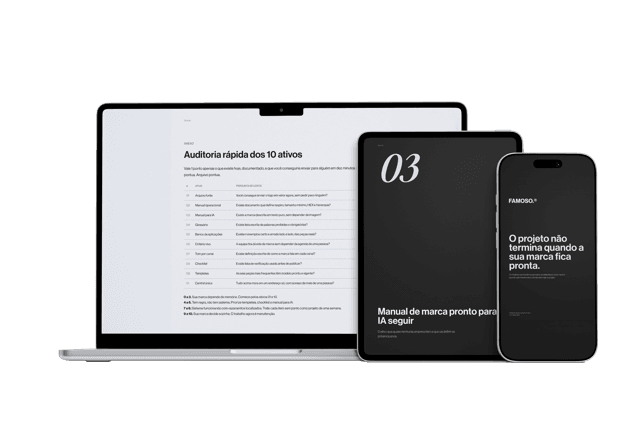
Material gratuito
E se a pessoa que criou sua marca sumisse amanhã?
Os 10 ativos que garantem que sua marca continue consistente, com ou sem quem a desenvolveu.
Posting more doesn't build authority. Repeating the same area of expertise, with the same perspective, over time, does. Authority is born from being predictable on a specific subject: when someone thinks of a problem and automatically remembers a person, that person has already built a personal brand, whether they posted yesterday or six months ago.
The founder's personal brand is a business asset, not an individual whim
When the founder is recognized as a reference, it cuts the sales work before the first conversation even happens. A client who already trusts the founder's perspective walks into a price negotiation with far less objection. It's the same logic as any brand: you don't sell what you do, you sell what you appear to do. The difference is that, in the founder's case, the brand has a face.
The risk of not deciding
A founder who avoids building a personal brand because they think it's vanity doesn't eliminate the problem, they just hand control of it to someone else. Whoever shows up with intention defines their own territory. Whoever doesn't show up lets the market define it for them, and the market, without information, tends to fill the void with the most generic version possible.
Perguntas frequentes
Is personal branding vanity?
No. Vanity is showing up to be seen; authority is showing up to be recognized for something specific. The first seeks attention, the second builds perception.
What happens if a founder doesn't build their own personal brand?
The market ends up deciding what they represent, shaped by someone else's comment, a random appearance, or silence interpreted however people like.
Does posting more build authority?
Not necessarily. Authority comes from repeating the same area of expertise with the same perspective over time, not from posting frequency.
Why does the founder's personal brand matter for the business?
Because when the founder is recognized as a reference, it cuts sales work before the first conversation even happens, since the client walks into a price negotiation with far less objection.
Material gratuito
E se a pessoa que criou sua marca sumisse amanhã?
Os 10 ativos que garantem que sua marca continue consistente, com ou sem quem a desenvolveu.
Ferramenta gratuita
Diagnóstico de marca
Responda o scorecard e receba o score da sua marca com uma leitura direta do resultado.
Fazer diagnóstico →
R$97
Agente FAMOSO.®
O processo que uso pra criar posts com tese, não conteúdo genérico. Acesso permanente.
Conhecer o agente →Leia também
- What brand positioning is (and why it costs you)Brand positioning isn't a slogan. It's the position your company occupies in the client's mind before any conversation. And it defines the price you can charge.
- Brand equity: why your brand may be worth moreBrand equity is the value your brand adds beyond the product itself. Understand how it affects price, preference, and growth.
- Why Your Brand Looks Amateur (and How to Fix It)Does your brand look amateur even though your business is serious? See the signs that make a brand look smaller than it is and what changes in perception.
- How to structure Instagram to sell a serviceWhatsApp has a 98% open rate, Instagram DMs sit near 60%. Profile structure decides whether the lead reaches the right channel or gets lost.
Escrito por Pedro Cardoso, fundador do FAMOSO.®, estúdio de branding em Porto Alegre.
← Ver todos os artigosDiagnóstico FAMOSO.®
Você não vende o que faz. Vende o que parece que faz.
Análise completa da sua marca mais uma call de 30 minutos. O valor vira crédito integral no projeto.
CONHECER O DIAGNÓSTICO