
Why Your Company Can't Charge More
You improved the product and still hear it's too expensive. The problem is almost never the price, it's the perception.
Neste artigo

You improved the product, hired good people, deliver better than half of your competitors. Even so, every time you try to raise the price, you lose the client or hear that it's "too expensive." The problem is almost never the product. It's the perception the market has before it even looks at the price.
Price isn't read in a vacuum. The person arrives at it already holding an expectation shaped by your brand, and that expectation decides whether the number looks fair or abusive. Two companies with the same product charge different amounts because one built the perception that sustains the price and the other didn't.
Price is compared to perception, not to cost
The client doesn't know your cost and doesn't care about it. When they see your price, they compare it to what they thought you were worth. If the brand communicates "ordinary company," any price above average looks expensive. If it communicates "reference company," the same number looks reasonable.
That's why raising the price without touching perception almost always fails. You raised the number, but the yardstick it's measured against stayed the same. The client feels like they're paying more for the same thing, because nothing in your brand said the thing had changed.
A cheap-looking brand is a decision you made without noticing
Nobody chooses to look cheap on purpose. It happens through the buildup of details nobody decided on. The logo that got outdated, the website that doesn't match the quality of the service, the communication that changes face with every post, the proposal that goes out in a plain document.
Each one is small. Together, they tell the client "this is cheaper than you thought." The brand becomes the silent answer to the question "how much should this cost," and if it answers "not much," your price fights against your own image. A brand that looks amateur is, at bottom, a brand that authorizes the client to pay less.
Chronic credit is a symptom, not a strategy
The company that can't raise its price usually falls back on recurring credit to close the sale. It becomes a cycle: you have to offer credit because perception doesn't support the full price, and every credit reinforces the perception that the full price was inflated.
Credit teaches the market to expect you cheaper. The client learns that your number has fat in it and starts negotiating by reflex. You're not selling at a lower price once in a while, you're re-educating the market about how much you're worth, downward.
Why the worse competitor charges more
Every owner has seen it: a competitor with an inferior product charging a lot more and selling. It's infuriating because it feels unfair, and it is. But it's not luck. They built a perception you didn't.
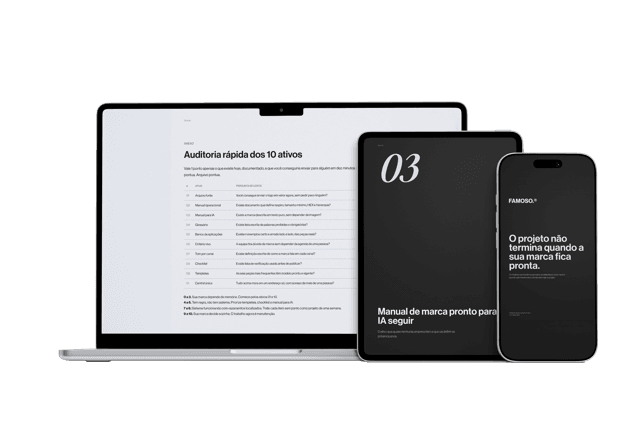
Material gratuito
E se a pessoa que criou sua marca sumisse amanhã?
Os 10 ativos que garantem que sua marca continue consistente, com ou sem quem a desenvolveu.
They invested in looking like what they charge. Their brand arrives before the product and prepares the client for the high price. When the client finally compares the two, they've already decided that one is the expensive-one-that's-worth-it and yours is the cheap-ordinary-one, even if delivery says the opposite. Brand positioning is exactly this fight over the yardstick you're measured with.
What changes when perception goes up
Raising perception isn't decoration. It's aligning everything the client sees with the value you deliver, so the price stops looking like an exaggeration and starts looking like coherence.
When the brand communicates the level of the service, three things change:
- →Price stops being the first objection. The conversation becomes about results, not the number.
- →Credit stops being mandatory to close. You sell at full value to those who understand the value.
- →You attract the client who compares by quality and push away the one who only compares by price. It's a trade of clientele, and it's the trade you want.
This is repositioning, not makeup. Brand repositioning is the work of changing perception so the price you deserve stops scaring people.
How to know if the problem is perception
A few signs indicate the block is in the brand, not in the product or the price itself.
You lose the sale on price, but the client praises the delivery afterward. The perception promised less than you delivered, so the price looked high at the moment of decision.
Your best clients came through referral, rarely through first contact with the brand. Whoever already trusts you pays, whoever just saw the brand thinks it's expensive. The difference between the two is the perception the brand builds on its own.
You're proud of the service and embarrassed to show the sales material. That mismatch between what you deliver and what you appear to be is the value left on the table.
Charging more doesn't start in a price spreadsheet. It starts in the answer your brand gives, before any conversation, to the question "how much is this worth." As long as that answer is smaller than your product, price will keep being the hardest fight in every sale. You don't sell what you do, you sell what you seem to do: first the market decides how much you seem to be worth, then it accepts or rejects the number.
Perguntas frequentes
Why can't I raise my prices even though my product improved?
Because price is compared to perception, not to cost. If the brand still communicates "ordinary company," raising the number alone doesn't change the yardstick clients measure it against, so the higher price just feels like paying more for the same thing.
What lets an inferior competitor get away with charging more?
They built a perception that arrives before the product and prepares the client to accept a higher price, so when the client compares the two, one already reads as worth it and the other as the cheap, ordinary option.
Is offering credit or lowering the price a good way to close more sales?
No, it's a symptom, not a strategy. Recurring credit teaches the market to expect you cheaper, and every instance reinforces the belief that your real price was inflated to begin with.
What real-world signs point to a perception problem instead of a pricing problem?
Losing sales on price but hearing the client praise the delivery afterward, best clients coming through referral rather than first contact with the brand, and feeling proud of the service but embarrassed by the sales materials.
Material gratuito
E se a pessoa que criou sua marca sumisse amanhã?
Os 10 ativos que garantem que sua marca continue consistente, com ou sem quem a desenvolveu.
Ferramenta gratuita
Diagnóstico de marca
Responda o scorecard e receba o score da sua marca com uma leitura direta do resultado.
Fazer diagnóstico →
R$97
Agente FAMOSO.®
O processo que uso pra criar posts com tese, não conteúdo genérico. Acesso permanente.
Conhecer o agente →Leia também
- What brand positioning is (and why it costs you)Brand positioning isn't a slogan. It's the position your company occupies in the client's mind before any conversation. And it defines the price you can charge.
- Why Your Brand Looks Amateur (and How to Fix It)Does your brand look amateur even though your business is serious? See the signs that make a brand look smaller than it is and what changes in perception.
- Brand repositioning: what it is and how to do itBrand repositioning isn't a visual overhaul. It's changing how the market perceives your business, and how to do it right.
- Brand equity: why your brand may be worth moreBrand equity is the value your brand adds beyond the product itself. Understand how it affects price, preference, and growth.
Escrito por Pedro Cardoso, fundador do FAMOSO.®, estúdio de branding em Porto Alegre.
← Ver todos os artigosDiagnóstico FAMOSO.®
Você não vende o que faz. Vende o que parece que faz.
Análise completa da sua marca mais uma call de 30 minutos. O valor vira crédito integral no projeto.
CONHECER O DIAGNÓSTICO