
Brand repositioning: what it is and how to do it
Brand repositioning isn't a visual overhaul. It's changing how the market perceives your business, and how to do it right.
Neste artigo

Brand repositioning is one of the most misunderstood decisions in the business world.
Most founders confuse it with redesign. They think changing the logo will fix it. Or that changing the color palette will solve the perception problem.
It won't.
What brand repositioning really is
Repositioning is changing the place your brand occupies in the client's mind.
It's not aesthetics. It's strategy.
Your brand occupies a position now. It might be 'the cheapest option on the market'. It might be 'that company that only serves big businesses'. It might be 'that freelancer who makes logos fast'.
That position was built over time, by everything you communicated, charged, delivered, and appeared to be.
Repositioning means leaving one position and building another.
When that repositioning extends into the entire visual identity as well, it becomes part of a rebranding.
When repositioning makes sense
There are four situations that indicate your brand needs repositioning.
- →Your price hasn't kept up with your capability. You've evolved. You serve better, deliver more, have more repertoire. But you still charge what you charged three years ago. And the client who reaches you is still the same profile as three years ago. The problem isn't your work. It's the perception the market has of you.
- →You consistently attract the wrong client. If every proposal becomes a price negotiation. If every client questions value before questioning quality. If you close projects with people who don't value what you deliver. That's not bad luck. It's wrong positioning.
- →You changed market or target audience. You started serving small businesses and want to move to companies with real revenue. You started in a niche and want to expand. You started as a generalist and want to specialize. Every change of audience requires a positioning review.
- →The market changed, your brand didn't. What communicated modernity five years ago may communicate backwardness today. Entire categories transform. Competitors emerge with more contemporary languages. Staying still is also a positioning choice. It's just usually the wrong one.
What repositioning is not
It's not just changing the logo.
It's not just updating the website.
It's not creating a new slogan and waiting for the market to notice.
Repositioning without strategy is makeup. It fixes the appearance for a while. It doesn't fix the perception.
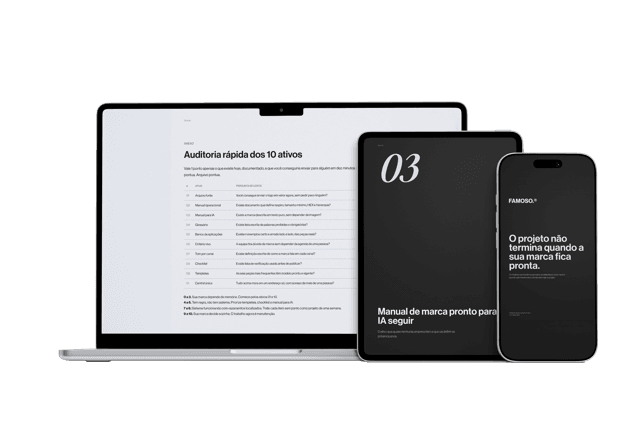
Material gratuito
E se a pessoa que criou sua marca sumisse amanhã?
Os 10 ativos que garantem que sua marca continue consistente, com ou sem quem a desenvolveu.
Perception is built by the sum of everything: what you charge, how you present yourself, which clients you accept, what you publish, how you behave in negotiation, who you're seen associating with.
Changing only one of these elements doesn't move the needle.
How repositioning works in practice
The process begins before any visual decision.
- →Diagnosis. Where your brand stands today in market perception. What people think when they hear your name. Which client you attract. Which client you lose. Which proposal you close. Which you don't.
- →Destination definition. Where you want to be. What perception you want to build. Which client you want to attract. Which ticket you want to charge. Which territory you want to occupy.
- →Perception gap. The distance between where you are and where you want to be. This gap determines the depth of the work.
- →Transition strategy. How you'll move perception. What changes in communication, offer, price, brand behavior. It's not a task list. It's a coherent system of signals.
- →Visual and verbal identity. Only here does design come in. Visual identity is the expression of the new positioning, not the positioning itself.
How long it takes
It depends on the distance between current and desired perception.
Incremental repositioning, where the brand is already on the right path but needs adjustment, can be perceived in six to twelve months.
Structural repositioning, where the change is of category or audience, takes longer. The identity changes quickly. Perception changes slowly.
The market needs repetition to update the image it has of a brand.
The most common mistake
Repositioning the identity without repositioning the behavior.
New brand. Same price. Same client. Same negotiation.
The market doesn't update perception by appearance. It updates by experience accumulated over time.
If you change how you look but don't change how you charge, deliver, and present yourself, the repositioning won't work.
Visual identity opens the conversation. Behavior sustains it.
If your brand looks smaller than the business you've built, the problem probably isn't the logo. It's the positioning.
Perguntas frequentes
Is brand repositioning the same as a visual makeover?
No. Repositioning means changing the position your brand occupies in the client's mind. It's not aesthetics, it's strategy, built by leaving one perception behind and constructing another.
How long does it take to see results from repositioning?
Incremental repositioning, where the brand is already on the right path but needs adjustment, can be perceived in six to twelve months. Structural repositioning, involving a change of category or audience, takes longer because the market needs repetition to update its image of a brand.
Is repositioning just about changing the logo or website?
No. It's explicitly not just changing the logo, not just updating the website, and not just writing a new slogan. Repositioning without a strategy behind it is just makeup that fixes appearance temporarily without fixing perception.
Why does repositioning sometimes fail to change anything?
The most common mistake is repositioning the visual identity without repositioning behavior, meaning you still charge the same price, serve the same client, and negotiate the same way. The market updates perception through experience over time, not through appearance alone.
Material gratuito
E se a pessoa que criou sua marca sumisse amanhã?
Os 10 ativos que garantem que sua marca continue consistente, com ou sem quem a desenvolveu.
Ferramenta gratuita
Diagnóstico de marca
Responda o scorecard e receba o score da sua marca com uma leitura direta do resultado.
Fazer diagnóstico →
R$97
Agente FAMOSO.®
O processo que uso pra criar posts com tese, não conteúdo genérico. Acesso permanente.
Conhecer o agente →Leia também
- What brand positioning is (and why it costs you)Brand positioning isn't a slogan. It's the position your company occupies in the client's mind before any conversation. And it defines the price you can charge.
- How to know if your brand needs rebranding7 concrete signs that your brand is limiting your business growth, and when rebranding won't fix it and is money wasted.
- Brand redesign: when it's worth itBrand redesign isn't about liking your logo more. It's about correcting what your perception is communicating wrong.
Escrito por Pedro Cardoso, fundador do FAMOSO.®, estúdio de branding em Porto Alegre.
← Ver todos os artigosDiagnóstico FAMOSO.®
Você não vende o que faz. Vende o que parece que faz.
Análise completa da sua marca mais uma call de 30 minutos. O valor vira crédito integral no projeto.
CONHECER O DIAGNÓSTICO