
How to choose a branding studio
A pretty portfolio is the weakest criterion. The questions that separate a branding studio from an art vendor, and what each price range actually buys.
Neste artigo
Choosing a branding studio is a decision most founders make with the wrong information. They look at a pretty portfolio, get three quotes, and pick the one in the middle. Six months later they have a new logo and the same perception problem they had before.
The portfolio shows what the studio can draw. It doesn't show whether they understand why your brand charges less than it should. Those are two different skills, and the second one is the one that moves your price.
A pretty portfolio is the weakest criterion
Every decent studio has a pretty portfolio. It's the floor of the profession, not the ceiling. Judging by it is like choosing a doctor by the waiting room.
What the portfolio hides: you see the final result, not the problem that existed before. A brand can turn out beautiful and not sell a single thing more. Ask for before-and-after with context. What the client wanted to change, what changed in their business afterward. A studio that only shows the art and can't tell you the effect works as an image vendor, not a positioning partner.
The question that separates a studio from an art vendor
In the first conversation, ask a simple question: how do you decide what my brand should communicate before drawing anything.
If the answer is about trends, visual references, or "let's do something clean and modern", you're talking to an art vendor. If the answer starts with questions about your market, your customer, and why they choose you over the competitor, you're talking to someone who understands that visual identity is a consequence of strategy, not the other way around.
The order matters. Design first, strategy later produces a pretty brand that doesn't sustain price. It's the most common mistake, and the most expensive.
What each price range actually buys
A serious visual identity project in Brazil typically runs between R$3,000 and R$30,000, and full repositioning projects easily go beyond that. The gap between the two ends isn't margin, it's scope and depth.
At the floor of the range you buy execution: a logo, a palette, a font, a file. At the top you buy diagnosis, positioning decisions, a complete visual system, and the strategy that explains why each choice exists. How much a professional visual identity costs gets into that detail.
The mistake is comparing two quotes as if they sell the same thing. They don't. One sells a file, the other sells perception. Ask what's included before comparing number to number.
Studio, agency, or freelancer
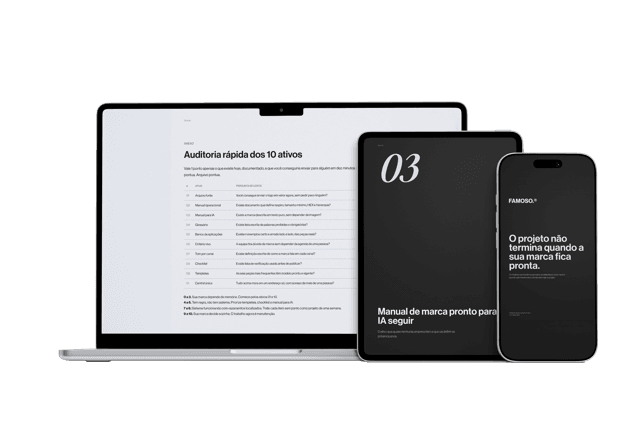
Material gratuito
E se a pessoa que criou sua marca sumisse amanhã?
Os 10 ativos que garantem que sua marca continue consistente, com ou sem quem a desenvolveu.
A freelancer works well when the problem is specific and you already know what you want: one piece of art, one adjustment, one specific material. Costs less and delivers fast.
A big agency makes sense when you need continuous volume, media, and several fronts at once. You pay for structure, and part of what you pay for is the structure, not the work.
A branding studio sits in the middle with a specific advantage: depth in positioning without the cost of an agency's structure. The work tends to be more authorial and closer to the decision-maker. The downside is capacity, a small studio takes on few projects at a time.
None of the three is better in the abstract. What changes is your problem. Repositioning a brand that turned into a commodity is studio or agency work, not freelancer work. Adjusting a piece of material is freelancer work, not studio work.
Warning signs before you sign
Some signs show up before the contract and matter more than any portfolio.
- →A promise of too short a timeline. Serious repositioning doesn't happen in a week, and whoever promises that is selling design, not diagnosis.
- →No questions about your business in the first meeting. If the studio already knows the solution before understanding the problem, the solution is generic.
- →A process that skips the strategy stage and goes straight to "logo options". You'll choose based on taste, and taste doesn't sustain price.
- →Reference work you can't tell apart from ten other studios. Lack of a signature style usually turns into lack of a signature in your project too.
How to run the first conversation
You don't need to understand design to run the first conversation. You need to listen to how the studio thinks.
Bring the problem, not the solution. Instead of "I need a new logo", say "my brand looks cheaper than what my product delivers". The first sentence asks for execution. The second asks for diagnosis, and the answer you get shows who you're talking to.
Ask them to explain the process from start to finish. A studio that works with a method can describe every stage and why it exists. A studio that improvises talks about inspiration and feeling. How the visual identity creation process works serves as a reference for comparison.
In the end, choosing a studio is choosing who will translate your business's value into perception. A good studio makes your brand read for what it's worth. The wrong studio does pretty work that doesn't change the price the market accepts to pay. The difference isn't in the portfolio. It's in the question they ask before opening the design program.
Perguntas frequentes
Is a pretty portfolio enough to choose a branding studio?
No. It's the floor of the profession, not the ceiling. The portfolio shows the final result, but it doesn't show whether the studio understands why your brand charges less than it should.
What question reveals whether I'm talking to a branding studio or an art vendor?
Ask how the studio decides what your brand should communicate before drawing anything. If the answer is about trends or something clean and modern, it's an art vendor.
Should I hire a freelancer, an agency, or a branding studio?
A freelancer handles a specific, quick problem. A big agency makes sense for continuous volume and several fronts. A branding studio sits in the middle, with depth in positioning without the cost of an agency's structure.
What warning signs suggest I should be wary of a studio before signing?
A promise of too short a timeline, no questions about your business in the first meeting, a process that skips straight to logo options, and a portfolio without a recognizable signature style.
Material gratuito
E se a pessoa que criou sua marca sumisse amanhã?
Os 10 ativos que garantem que sua marca continue consistente, com ou sem quem a desenvolveu.
Ferramenta gratuita
Diagnóstico de marca
Responda o scorecard e receba o score da sua marca com uma leitura direta do resultado.
Fazer diagnóstico →
R$97
Agente FAMOSO.®
O processo que uso pra criar posts com tese, não conteúdo genérico. Acesso permanente.
Conhecer o agente →Leia também
- Brand repositioning: what it is and how to do itBrand repositioning isn't a visual overhaul. It's changing how the market perceives your business, and how to do it right.
- How much does professional visual identity cost?Professional visual identity in Brazil costs between R$3,000 and R$30,000. Understand what separates the three service types.
- What Is a Brand Diagnosis and When to Do OneA brand diagnosis is the analysis that shows why a brand looks smaller than the business. Understand what it is, how it works, and when it's worth doing.
- Visual identity creation: how it actually worksMost people think creating a visual identity means showing logo options until one sticks. It's not. See how the real process works, from foundation to delivery.
- How to know if your brand needs rebranding7 concrete signs that your brand is limiting your business growth, and when rebranding won't fix it and is money wasted.
- How to structure Instagram to sell a serviceWhatsApp has a 98% open rate, Instagram DMs sit near 60%. Profile structure decides whether the lead reaches the right channel or gets lost.
Escrito por Pedro Cardoso, fundador do FAMOSO.®, estúdio de branding em Porto Alegre.
← Ver todos os artigosDiagnóstico FAMOSO.®
Você não vende o que faz. Vende o que parece que faz.
Análise completa da sua marca mais uma call de 30 minutos. O valor vira crédito integral no projeto.
CONHECER O DIAGNÓSTICO