
Personas do not decide purchases. Criteria do
Maria, 34, into yoga and travel. That profile card has never changed a brand decision. What to use instead to get your offer and messaging right.
Neste artigo
Every marketing deck has that slide. A stock photo, an invented name, age, marital status, hobby, and a quote in quotation marks the person never said. Maria, 34, lives in São Paulo, into yoga, values practicality.
Now answer this: what exactly changes in your business if Maria is 41 and into running instead.
Nothing. And that is the problem.
Fiction that feels like work
Personas became a mandatory step because they fill a real need: they give the team the sense that it understands the customer. The problem is that almost every persona is built from what is easy to find out, not from what decides the purchase.
Age, city, income and hobbies are easy to write down and explain nothing about why someone bought from you instead of the competitor. Research from the Ehrenberg-Bass Institute, systematized by Byron Sharp in How Brands Grow, shows exactly that: buyers of competing brands within the same category look very similar demographically. Whoever buys from you looks like whoever buys from your competitor. The difference is in the moment and the criteria, not the biography.
What actually decides a purchase
The best known example came from a study reported by Clayton Christensen about milkshake sales at a fast food chain. The company had detailed personas and kept improving the product according to customer profiles, with no results.
When someone went to observe actual behavior, a different fact appeared: roughly 40% of milkshakes were sold early in the morning, bought by people alone, to go. They did not want dessert. They wanted something that would last the drive to work and occupy one hand. The milkshake's competitor was not ice cream, it was a banana and a breakfast sandwich.
No demographic card would lead to that conclusion. Looking at the situation of use did.
What to use instead of a persona
Swap the biography for four questions that actually change decisions:
- →Trigger: what happened in the week the person decided to go looking. Almost every purchase has an event before it: they lost a contract, a partner came in, a competitor launched something, the factory doubled in size.
- →Choice criteria: which three things they compared across suppliers, in the order they compared them. That defines what has to be visible on your site and in your proposal.
- →Alternative considered: what you were really compared against, including doing nothing, which is usually the strongest competitor of all.
- →Blocking fear: what almost stopped the purchase. That is what your messaging has to neutralize before the person asks.
You can get those four answers in half an hour of conversation with five customers who already bought. It is not expensive research, it is a phone call.
The practical gain
Personas produce slides. Criteria produce decisions.
If you find out the recurring trigger is an investor came in and the brand got too small for the new story, that changes the first sentence on your homepage, changes the example you use on calls, and even changes which product you put in front. If you find out the blocking fear is I will depend on the supplier for every little change, that becomes a line in the proposal that resolves the objection before it exists.
Maria's profile card changes none of that, because you wrote it, about someone who does not exist, with information that does not influence buying. It is an exercise in imagination signed as research.
Real customers have already answered everything you need to know. What is missing is asking the right things and dropping the invented rest.
Perguntas frequentes
Are personas useless?
They are close to useless when built from invented demographic data. What changes decisions is the buying situation: trigger, choice criteria, alternative considered and blocking fear.
Why does demographic profiling not differentiate customers?
Ehrenberg-Bass Institute research shows that buyers of competing brands in the same category have very similar profiles. The difference lies in the moment and the criteria, not the biography.
What does the milkshake case teach?
That observing the situation of use reveals the real competitor. Roughly 40% of sales happened in the morning, for solo consumption during the commute, which put the product up against a banana and a quick breakfast, not against dessert.
How do I gather this without expensive research?
By talking for half an hour with five customers who already bought, asking what triggered the search, what they compared, who else they considered, and what almost stopped the purchase.
Material gratuito
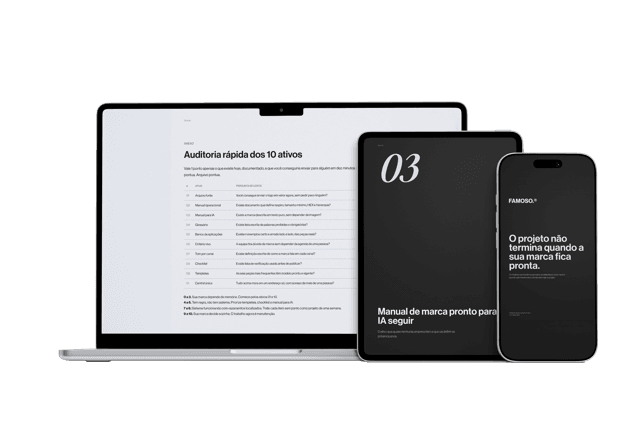
E se a pessoa que criou sua marca sumisse amanhã?
Os 10 ativos que garantem que sua marca continue consistente, com ou sem quem a desenvolveu.
Ferramenta gratuita
Diagnóstico de marca
Responda o scorecard e receba o score da sua marca com uma leitura direta do resultado.
Fazer diagnóstico →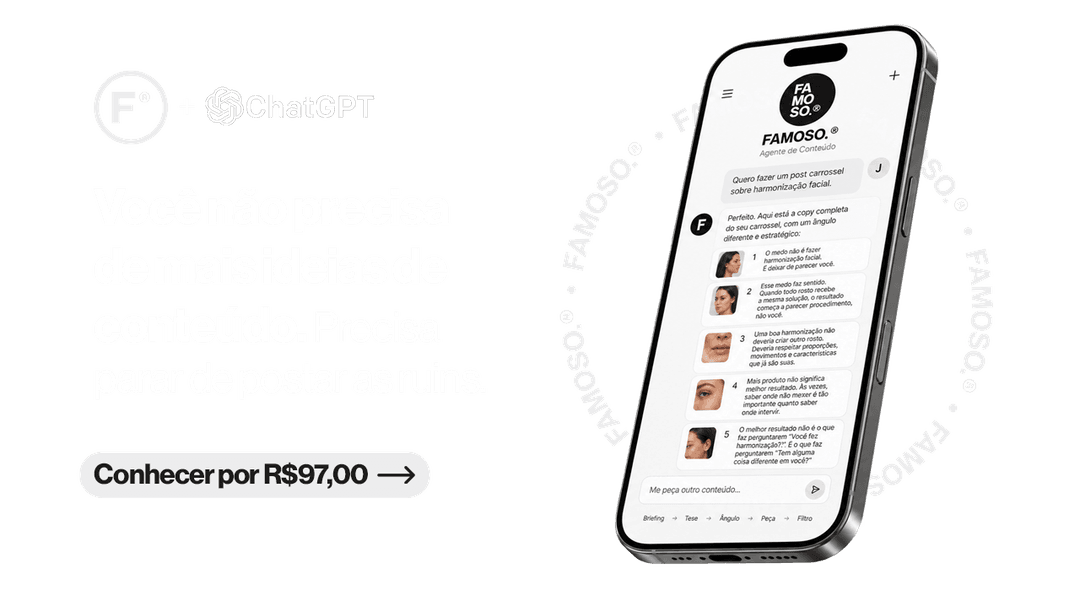
R$97
Agente FAMOSO.®
O processo que uso pra criar posts com tese, não conteúdo genérico. Acesso permanente.
Conhecer o agente →Leia também
- What Is a Brand Diagnosis and When to Do OneA brand diagnosis is the analysis that shows why a brand looks smaller than the business. Understand what it is, how it works, and when it's worth doing.
- What brand positioning is (and why it costs you)Brand positioning isn't a slogan. It's the position your company occupies in the client's mind before any conversation. And it defines the price you can charge.
- Brand tone of voice: what it is and how to define yoursBrand tone of voice is your company's personality expressed in words. Understand what it is, why it matters, and how to define yours with clarity.
- Branding strategy: what it is and how it worksBranding strategy isn't about having a nice logo. It's deciding what your brand means and how it's perceived.
Escrito por Pedro Cardoso, fundador do FAMOSO.®, estúdio de branding em Porto Alegre.
← Ver todos os artigosDiagnóstico FAMOSO.®
Você não vende o que faz. Vende o que parece que faz.
Análise completa da sua marca mais uma call de 30 minutos. O valor vira crédito integral no projeto.
CONHECER O DIAGNÓSTICO