
Brand tone of voice: what it is and how to define yours
Brand tone of voice is your company's personality expressed in words. Understand what it is, why it matters, and how to define yours with clarity.
Neste artigo
Two brands can sell the same product, charge the same price, and have the same visual identity.
What differentiates one from the other in the client's mind is how they speak.
That's tone of voice.
What brand tone of voice is
Tone of voice is your brand's personality expressed in language.
It's the set of choices that defines how your company communicates: the words it uses, the ones it avoids, the rhythm of sentences, the level of formality, the humor or lack of it, how it treats the client, presents a proposal, responds to criticism.
A brand that speaks with authority and without beating around the bush has one tone. A brand that speaks like a friend has another. A brand that speaks like a technical expert has another.
None is right or wrong. The right tone is the one aligned with the positioning.
Why tone of voice matters
Because the client reads before buying.
Before closing a project, they'll read your bio, your website, your posts, your emails, your proposals. They'll form an impression. They'll decide if they trust you. They'll decide if you seem to be at their level.
If your work is premium but your communication looks amateur, too informal, or generic, you've lost the client before opening your mouth.
Tone of voice is perception. You don't sell what you do, you sell what you seem to do.
The difference between tone of voice and verbal identity
They are closely related but distinct concepts.
- →Verbal identity is the brand's complete language system. It includes name, slogan, product naming, proprietary vocabulary, key messages, and tone of voice.
- →Tone of voice is how all of that sounds. It's the execution, the style, the personality in practice.
You can have a very well-defined verbal identity and execute it with the wrong tone.
How to define your brand's tone of voice
The process starts with four questions.
- →Who is your brand if it were a person? Think in real characteristics. Not in vague adjectives like 'innovative' or 'trustworthy'. Think in behavior. Is it direct or diplomatic? Serious or humorous? Technical or accessible? Formal or colloquial? Does it provoke or reassure?
- →Who is your client? The tone needs to speak to who you want to attract. A client who values technical expertise responds differently from one who wants a partnership. A mid-size company founder reads differently from a starting entrepreneur. Tone of voice isn't about what you prefer. It's about what connects with who pays.
- →Who are your competitors and how do they speak? If everyone in your market speaks the same way, speaking differently is differentiation. If everyone is informal and colloquial, being more direct and technical is already a territory.
- →What perception do you want to build? Authority? Proximity? Sophistication? Irreverence? Each perception has a language that sustains it.
The four tone of voice attributes
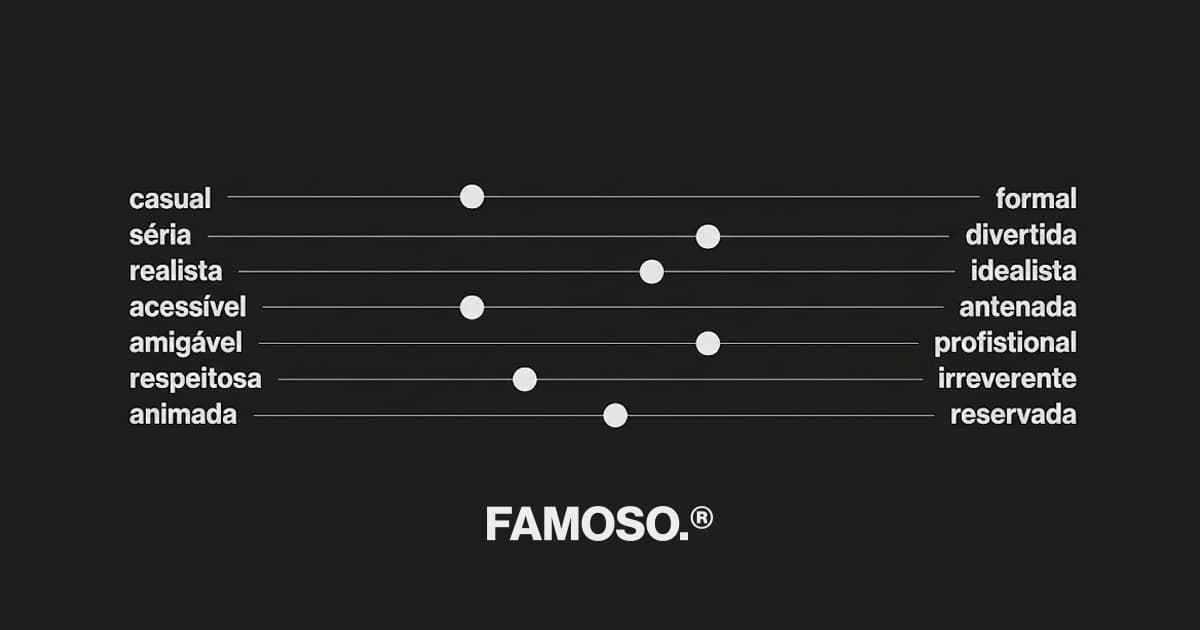
A practical way to document tone of voice is to define four attributes on a scale.
They're not right or wrong, they're positions on a spectrum.
- →Formal, Informal
- →Serious, Humorous
- →Technical, Accessible
- →Distant, Close
Where your brand positions itself on each of these axes determines the tone.
A premium consulting brand can be formal, serious, technical, and slightly distant. A design brand for small businesses can be informal, light, accessible, and close.
The most common problem is wanting to be everything at once. Tone of voice without a clear position becomes noise.
What tone of voice affects in practice
Everything the brand writes or says.
Social media posts. Website texts. Commercial proposals. Reply emails. Presentations. Photo captions. Service descriptions. WhatsApp messages. System notifications.
If every touchpoint sounds different, the brand seems inconsistent. And inconsistency destroys trust.
Consistent tone of voice creates recognition. The client starts identifying the brand's voice even before seeing the logo.
The most common mistake
Defining a tone of voice on paper and not applying it in practice.
Many brands have a beautiful manual that says 'we are direct, objective, and without fluff' and publish texts full of 'in the current scenario', 'in order to', and 'with regard to'.
Tone of voice doesn't exist in the manual. It exists in the published text, the sent proposal, the answered email.
Consistency is what transforms tone into identity.
Your brand has a tone of voice right now. It may be that you chose it. It may be that it emerged without intention.
The difference is that the tone chosen with strategy attracts the right client. The tone that emerged without intention attracts anyone.
Perguntas frequentes
What exactly counts as a brand's tone of voice?
It's your company's personality expressed in language: the words you use and avoid, the rhythm of sentences, the level of formality, and how you treat a client or respond to criticism.
Is tone of voice the same thing as verbal identity?
No. Verbal identity is the brand's complete language system, including name, slogan, product naming, and key messages. Tone of voice is how all of that actually sounds, the execution and personality in practice.
What attributes should I define to set my brand's tone of voice?
Four attributes on a scale: formal to informal, serious to humorous, technical to accessible, and distant to close. Where your brand sits on each axis determines the tone.
Why does inconsistent tone of voice hurt a brand?
If every touchpoint, from posts to proposals to emails, sounds different, the brand seems inconsistent, and inconsistency destroys the trust that a recognizable voice would otherwise build.
Material gratuito
E se a pessoa que criou sua marca sumisse amanhã?
Os 10 ativos que garantem que sua marca continue consistente, com ou sem quem a desenvolveu.
Ferramenta gratuita
Diagnóstico de marca
Responda o scorecard e receba o score da sua marca com uma leitura direta do resultado.
Fazer diagnóstico →
R$97
Agente FAMOSO.®
O processo que uso pra criar posts com tese, não conteúdo genérico. Acesso permanente.
Conhecer o agente →Leia também
- What is visual identity, really?Visual identity is what makes your brand perceived a specific way before a word is said. Most companies treat it as just the logo.
- Branding strategy: what it is and how it worksBranding strategy isn't about having a nice logo. It's deciding what your brand means and how it's perceived.
- What a visual identity manual actually doesA visual identity manual isn't a file to store. It's the document that ensures your brand remains the same wherever it appears.
Escrito por Pedro Cardoso, fundador do FAMOSO.®, estúdio de branding em Porto Alegre.
← Ver todos os artigosDiagnóstico FAMOSO.®
Você não vende o que faz. Vende o que parece que faz.
Análise completa da sua marca mais uma call de 30 minutos. O valor vira crédito integral no projeto.
CONHECER O DIAGNÓSTICO