
What is rebranding, really?
Rebranding isn't changing the logo. It's realigning perception with the level the business has already reached.
Neste artigo

Most people think rebranding is changing the logo.
Change the logo, change the color, and done, 'we did a rebranding'.
It's not that. And confusing the two is why so many companies spend on a new brand and still have the same problem as before.
What rebranding is
Rebranding is the process of realigning a brand's perception with what the business really is today.
It's not aesthetics. It's perception correction.
When a company grows, improves delivery, and levels up, but the brand continues communicating the previous stage, a gap opens. On one side, what the business became. On the other, what the brand still says it is. Rebranding is the work of closing that gap.
That's why it touches more than just the logo. It touches how the brand positions itself, how it speaks, what it communicates before the first word, and how the market perceives it.
What rebranding is not
Three terms are constantly confused with rebranding. It's worth separating them, because the confusion costs money.
Redesign is a visual change. New logo, new palette, new graphic system. It can be part of a rebranding, but alone it's just new aesthetics over the same strategy.
Repositioning is a strategy change. It changes who the brand speaks to, what place it occupies in the market, what perception it wants to install. It can happen within a rebranding, but it's the strategic layer, not the visual one.
Rebranding is the umbrella. It can involve redesign, it can involve repositioning, it can involve both. What defines it is the intention: to realign the entire brand with the current business, not to change one piece.
What rebranding involves
A complete rebranding usually touches four layers.
Positioning. Where the brand places itself, who it speaks to, what it promises. It's the foundation. Without this, everything else is decoration.
Visual identity. Logo, palette, typography, application system. It's the visible manifestation of the strategy.
Tone of voice. How the brand speaks, what personality it carries in communication. Two brands with the same visual identity sound different through their tone.
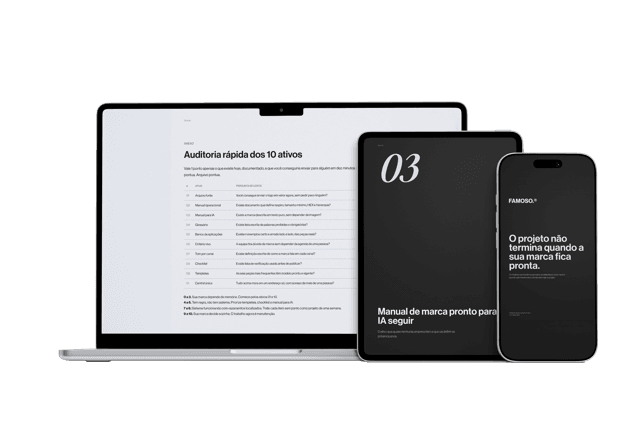
Material gratuito
E se a pessoa que criou sua marca sumisse amanhã?
Os 10 ativos que garantem que sua marca continue consistente, com ou sem quem a desenvolveu.
Application. How all of this lives in real touchpoints: website, proposal, presentation, profile, stationery. This is where perception actually happens.
Not every rebranding touches all four layers. It depends on the size of the mismatch.
The two types of rebranding
There are two types, and the difference lies in depth.
Partial rebranding keeps the brand's essence and updates its form. The company continues to be recognized, but with an appearance and communication more in line with what it is today. It's the most common case in businesses that have grown and just need the brand to catch up.
Full rebranding reconstructs the brand from positioning up. It happens when the business has changed so much, or the brand has fallen so far behind, that updating the form doesn't resolve it.
Most businesses looking for rebranding need the partial kind. They think they need the full kind because they feel the size of the discomfort, not the actual size of the problem.
Why companies rebrand
The reason is almost never aesthetic.
It's commercial. An outdated brand charges every month: in the discount the client asks for before negotiating, in the lead who disappears after the quote, in the worse competitor who looks bigger and closes what was yours.
Rebranding exists to stop that leak. Not to make the brand beautiful. To make it work in favor of the sale instead of against it.
Knowing when the time has come is another matter. There are specific signs that indicate the moment.
Rebranding starts with perception, not the logo
Well-done rebranding doesn't start with the logo. It starts with perception.
The right question isn't 'what new logo do I want'. It's 'what is my brand communicating today, and how much is that below what my business delivers'.
That's the calculation that determines whether it's worth it or not. And it's exactly what a diagnosis shows before any change.
Perguntas frequentes
Does rebranding just mean getting a new logo?
No. Rebranding is the process of realigning a brand's perception with what the business really is today. It's perception correction, not aesthetics.
What's the difference between rebranding, redesign, and repositioning?
Redesign is just a visual change, new logo, palette, and graphic system. Repositioning is a strategy change, who the brand speaks to and what perception it wants to install. Rebranding is the umbrella that can involve either or both, aimed at realigning the entire brand with the current business.
What are the four layers a full rebranding can touch?
Positioning, visual identity, tone of voice, and application, meaning how all of it shows up in real touchpoints like the website and proposals.
What's the difference between partial and full rebranding?
Partial rebranding keeps the brand's essence and updates its form, the most common case for businesses that have grown. Full rebranding reconstructs the brand from positioning up, needed when the business has changed drastically or the brand has fallen far behind.
Material gratuito
E se a pessoa que criou sua marca sumisse amanhã?
Os 10 ativos que garantem que sua marca continue consistente, com ou sem quem a desenvolveu.
Ferramenta gratuita
Diagnóstico de marca
Responda o scorecard e receba o score da sua marca com uma leitura direta do resultado.
Fazer diagnóstico →
R$97
Agente FAMOSO.®
O processo que uso pra criar posts com tese, não conteúdo genérico. Acesso permanente.
Conhecer o agente →Leia também
- How to know if your brand needs rebranding7 concrete signs that your brand is limiting your business growth, and when rebranding won't fix it and is money wasted.
- Brand redesign: when it's worth itBrand redesign isn't about liking your logo more. It's about correcting what your perception is communicating wrong.
- Brand repositioning: what it is and how to do itBrand repositioning isn't a visual overhaul. It's changing how the market perceives your business, and how to do it right.
Escrito por Pedro Cardoso, fundador do FAMOSO.®, estúdio de branding em Porto Alegre.
← Ver todos os artigosDiagnóstico FAMOSO.®
Você não vende o que faz. Vende o que parece que faz.
Análise completa da sua marca mais uma call de 30 minutos. O valor vira crédito integral no projeto.
CONHECER O DIAGNÓSTICO