
Ronaldinho's last match: September 2015, Fluminense
Ronaldinho last played professionally in 2015 and retired in 2018. Eleven years on, the brand is worth around R$600M. What kept paying without the game.
Neste artigo
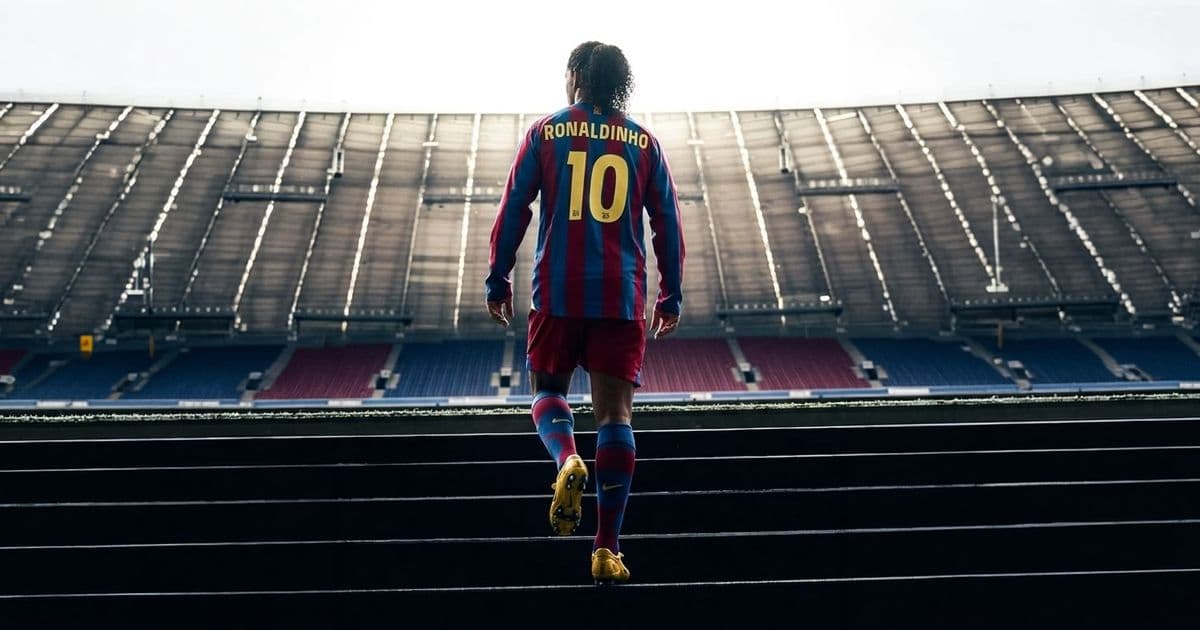
Ronaldinho Gaúcho played his last professional match in September 2015, for Fluminense. The formal retirement announcement only came in 2018. It's been 11 years since he last stepped on a field paid to play well. It's been 21 years since he won the Ballon d'Or, in 2005, the year most people still associate with his name.
In July 2026, he launched Use Ronaldinho, his own clothing brand in partnership with Momentus Fashion Company. In September, he takes the stage at iFood Move, an event that brings together 12,000 restaurant, retail, and convenience-store business owners, to talk about building legacy. He's also a shareholder in a club eyeing the MLS and a partner in a record label based in Miami. His estimated net worth in 2026 sits between R$580 and R$600 million.
None of these activities depends on him playing soccer. And that's exactly the point.
The product disappeared, the brand stayed
The Ronaldinho case is the cleanest experiment there is of a principle that seems abstract until you see the number: there's a difference between the product that creates perception and the perception itself, and after a while they separate. The dribble, the backheel goal, the Ballon d'Or, that was the product. It lasted a decade of elite-level career. The perception of "creative, joyful genius" outlived the product for more than two decades and is now being sold in categories that have nothing to do with soccer: fashion, corporate speaking, music, sports investment in the United States.
Whoever pays him to speak at an iFood event isn't buying access to an active player. They're buying the right to associate their own company's brand with a perception Ronaldinho built 20 years ago and never stopped keeping alive.
Why the fashion brand needs a holographic seal
Use Ronaldinho isn't a licensed line with a name slapped on it, it's presented as a signature brand, with an official logo application, custom tags, and holographic seals designed specifically to reinforce authenticity and exclusivity.
Material gratuito
E se a pessoa que criou sua marca sumisse amanhã?
Os 10 ativos que garantem que sua marca continue consistente, com ou sem quem a desenvolveu.
That's the design data point that shows the mechanism at work. The further away the original proof of talent gets, the goal seen live, the dribble everyone talked about the next day, the more the brand needs a visual device to do the proof work that memory used to handle on its own. Holographic seal, numbered tag, specific logo application: all of it is manufactured authenticity, built to replace what once proved itself alone, live, on the field. Design, in this case, isn't decorating the shirt, it's holding up credibility that time has already started erasing.
What it teaches about pricing
A personal or business brand that only holds value while the original product is in the spotlight is fragile. The brand that holds value independent of the original product, because the perception it generated was well managed, becomes an asset that sells in categories with no relation to its origin. Ronaldinho no longer sells soccer. He sells the memory of what his soccer represented, packaged into clothing, stages, and equity stakes.
What this leaves for those who aren't soccer players
Most businesses treat perception as an automatic shadow of the product: "if the product is good, the brand takes care of itself." The Ronaldinho case proves the opposite. Perception needs to be actively managed, with visual devices and consistent presence, because without that it evaporates at the same pace as the memory of the original product.
It's the kind of gap FAMOSO.®'s brand diagnosis exists to map: finding out what actually sustains a business's perception today, which may no longer be what sustained it five years ago, before deciding on price or positioning on top of a foundation that already shifted without notice.
Ronaldinho didn't stop selling. He just swapped the product that sustains the sale, from the dribble to the holographic seal. The brand survived because someone actively took care of it while the soccer faded into the past.
Perguntas frequentes
When did Ronaldinho Gaúcho retire from soccer?
His last professional match was in September 2015, for Fluminense. The formal retirement announcement came in 2018.
What is Use Ronaldinho?
It's the clothing brand launched by Ronaldinho Gaúcho in July 2026, in partnership with Momentus Fashion Company, featuring an official logo application, custom tags, and holographic seals.
What is Ronaldinho Gaúcho's net worth in 2026?
Estimated between R$580 and R$600 million, spread across real estate, financial investments, and stakes in businesses including fashion, music, and a club eyeing the MLS.
Why can Ronaldinho still charge high fees without playing soccer?
Because the brand perception he built during his career, associated with creativity and joy, has been kept active over two decades and is now sold in categories with no direct relation to soccer, such as fashion and corporate speaking.
Material gratuito
E se a pessoa que criou sua marca sumisse amanhã?
Os 10 ativos que garantem que sua marca continue consistente, com ou sem quem a desenvolveu.
Ferramenta gratuita
Diagnóstico de marca
Responda o scorecard e receba o score da sua marca com uma leitura direta do resultado.
Fazer diagnóstico →
R$97
Agente FAMOSO.®
O processo que uso pra criar posts com tese, não conteúdo genérico. Acesso permanente.
Conhecer o agente →Leia também
- Personal branding: authority isn't vanityA founder who doesn't build a personal brand leaves the perception of their own expertise to chance. Personal branding is a business decision, not vanity.
- Number 10 jersey: what it means in footballThe number 10 was not born special. Pelé, Maradona, Zico and Messi stacked meaning onto it for decades. Where the weight of the 10 actually comes from.
- Brand equity: why your brand may be worth moreBrand equity is the value your brand adds beyond the product itself. Understand how it affects price, preference, and growth.
- Messi vs. Cristiano Ronaldo: Two Personal BrandsBoth reached the top through opposite paths. One let performance speak, the other ran his image like a company.
- How many hours does Haaland sleep? The full routineHaaland sleeps around ten hours a night, eats 6,000 calories a day and tapes his mouth shut. The whole routine, and why repetition became his brand.
Escrito por Pedro Cardoso, fundador do FAMOSO.®, estúdio de branding em Porto Alegre.
← Ver todos os artigosDiagnóstico FAMOSO.®
Você não vende o que faz. Vende o que parece que faz.
Análise completa da sua marca mais uma call de 30 minutos. O valor vira crédito integral no projeto.
CONHECER O DIAGNÓSTICO